

Water is a strategic resource. Behind every desalination plant, every distribution network and every water treatment system lies a precision engineering discipline that is rarely visible yet absolutely critical: industrial valves. Within this field, large-dimension valves represent some of the most demanding and consequential components in the entire hydraulic infrastructure.
Why the Water Sector Requires Large-Dimension Valves
Desalination plants, water treatment stations and large supply networks operate at flow rates and pressures that demand components of considerable scale. When the fluid bore diameter is large, and when the operating pressure is high, valve size increases proportionally.
This reality imposes design and manufacturing conditions that go well beyond conventional practice. It is not sufficient for a valve to function: it must do so within minimal tolerances, over decades of service, in permanent contact with corrosive media such as seawater or chlorinated water, and under opening and closing cycles that repeat thousands of times throughout its working life.
Modern hydraulic infrastructure, from large reverse osmosis desalination plants to urban distribution systems, depends on these valves performing without fault. Failure in a component of this kind can result in the collapse of potable water supply to entire cities, or the shutdown of a plant whose daily output is measured in millions of cubic metres.
Types of Industrial Valves Most Commonly Used in Water and Desalination
Not all valves are alike, nor do they serve the same purposes. Depending on their operating principle, each type offers specific advantages for different points in the process.
Plug Valves
Plug valves are a type of isolation valve in which a conical or cylindrical element, the plug, rotates on its own axis to open or close fluid passage through a port machined into its body. Their robust design and capacity to achieve a rapid, tight seal make them a common solution at process points where reliable isolation is required with agile actuation.
In the water and desalination sector, plug valves are used primarily in blowdown circuits, branch connections and sampling points, as well as in installations where overall compactness is a determining factor. Machining the conical surface of the plug and its mating body demands a high degree of geometric precision: any deviation in taper or surface finish at the contact faces compromises sealing integrity and shortens service life, particularly in media containing chlorides or suspended solids.
Butterfly Valves
Butterfly valves are one of the most widely used solutions in the water sector, valued for their compact design and excellent size-to-flow capacity ratio. A circular disc rotates on a shaft to regulate or shut off fluid flow, making them particularly well suited to large-diameter pipelines where available space is limited.
In desalination applications, butterfly valves are used on both incoming seawater lines and outgoing brine circuits. Their capacity to operate across very large diameters, combined with relatively straightforward maintenance, makes them a preferred choice among project engineers. Precise machining of the body and disc is critical to ensuring sealing performance and service life.
Gate Valves
Gate valves are the reference standard for line isolation in hydraulic infrastructure. Their operating principle, a gate that moves perpendicular to the flow, ensures minimal pressure drop in the open position, making them ideal for main water conveyance lines.
In large water treatment installations and in the high-pressure lines of desalination plants, large-dimension gate valves are front-line components. When these parts exceed certain diameters, the flatness requirements of the seats, the concentricity of the gate and the surface finish of the bodies can only be guaranteed with high-capacity machining equipment.
Control Valves
Precise regulation of flow and pressure is fundamental to water treatment and desalination processes. Control valves are the components that manage these variables in real time, responding to signals from the plant's automation systems.
In a reverse osmosis plant, for example, control valves manage the feed pressure to the membranes, which can exceed 70 bar in certain configurations. The machining precision of the obturator and seat directly determines the component's regulation capacity and, by extension, the energy efficiency of the entire process.
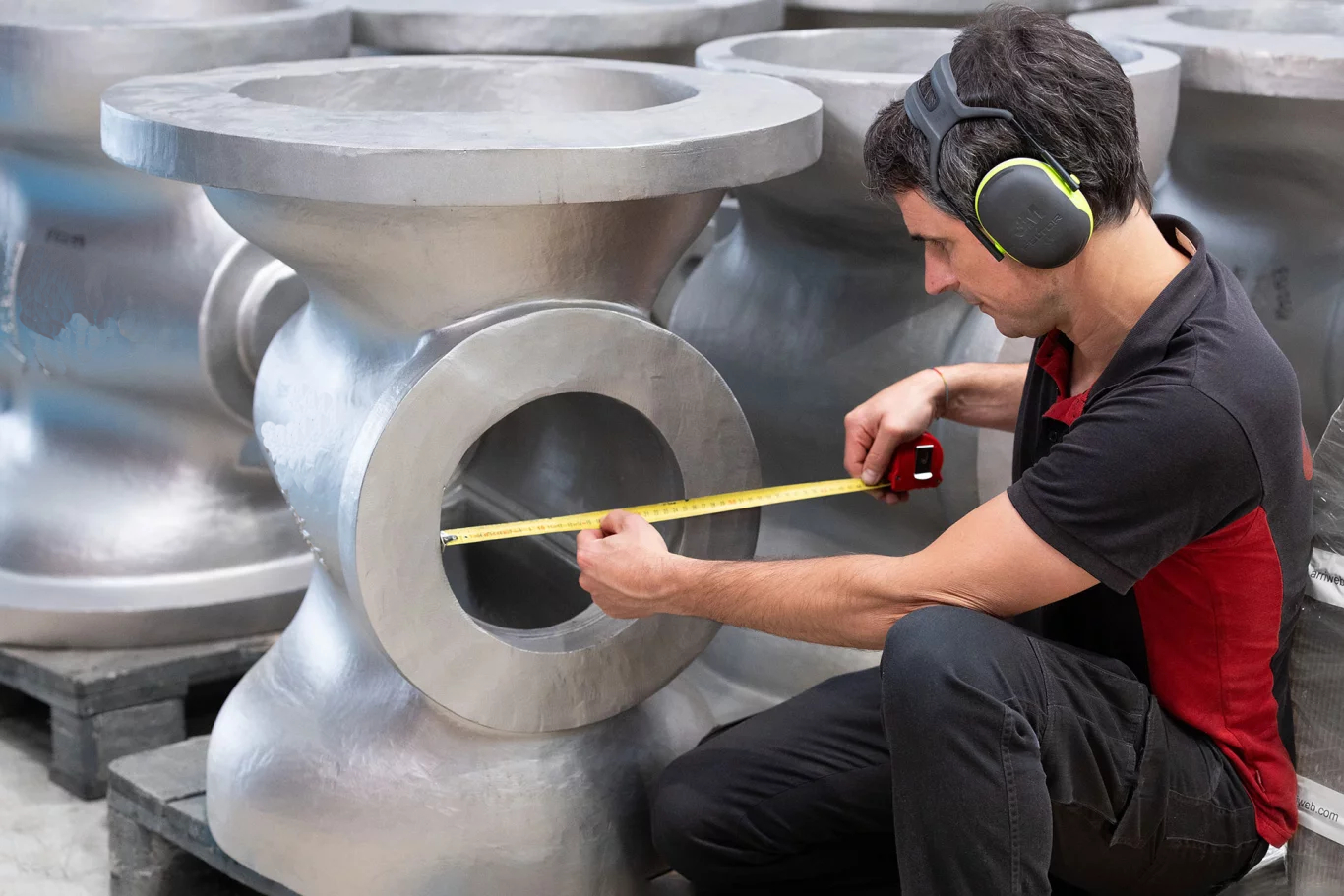
Materials: The Response to Corrosion and Durability
One of the principal challenges in the water and desalination sector is the chemical aggressiveness of the fluids involved. Seawater is one of the most corrosive media encountered in industry: with chloride concentrations that can exceed 35,000 ppm, it rapidly attacks materials that would otherwise have a service life spanning decades.
For this reason, stainless steel valves are the predominant choice for lines in contact with seawater and brine. High-alloy austenitic stainless steels, such as 316L, offer significantly greater corrosion resistance than carbon steels. However, for the most demanding conditions, engineers turn to materials with even greater resistance:
-
Duplex and super-duplex steel: combining high mechanical strength with excellent resistance to pitting and crevice corrosion. These are the reference material for many desalination applications.
-
Inconel and other superalloys: used in components subject to extreme combinations of temperature, pressure and corrosion.
-
Nodular cast iron and forged steel: high-reliability solutions for large-scale components in circuits with lower chemical aggressiveness.
Machining these materials requires specific expertise and adapted tooling. Stainless steel and duplex valves in particular exhibit cutting behaviour very different from that of conventional steels, and require precisely calculated machining parameters to prevent work hardening and achieve the required surface finish.
Specific Applications in Water Treatment and Desalination
Reverse Osmosis Desalination Plants
Reverse osmosis desalination plants are the installations where large-dimension valves play the most prominent role. From coastal seawater intakes to the high-pressure lines feeding the membranes, through energy recovery systems and brine circuits, each section of the process requires specific industrial valves, with materials and tolerances matched to its operating conditions.
Butterfly valves and gate valves are the most widely used components on larger-diameter lines, while control valves manage pressure and flow at the critical points of the process.
Wastewater Treatment Stations
Wastewater treatment is another major field of application. Treatment stations handle large volumes of water across different process stages — pre-treatment, biological treatment, clarification and disinfection — with valves that must operate reliably for years in media containing suspended solids, gases and chemical agents.
Industrial valves for wastewater treatment must be robust, easy to maintain, and capable of withstanding cyclic operating conditions. Machining valve bodies and obturators to specific surface finishes that prevent solid adhesion and facilitate cleaning is a critical consideration in this type of application.
Supply and Distribution Networks
Water supply infrastructure, encompassing large mains, pumping stations and balancing reservoirs, also depends on large-dimension valves for flow and pressure control at various points across the network. Gate valves and butterfly valves are the leading components in these applications, where long-term reliability and low maintenance costs are the primary selection criteria.
ARRI: Over 30 Years Serving the Water Sector
Talleres Mecánicos ARRI, based in Beasain (Basque Country), is a reference in the machining of large-dimension industrial valves. With a workforce of 60 highly qualified professionals and 3,500 m² of facilities equipped with the most advanced technology, ARRI delivers machining solutions for the world's most demanding markets.
More than three decades of accumulated experience in the industrial valve sector have allowed ARRI to develop an in-depth understanding of the materials, processes and quality standards required by water and desalination projects. From stainless steel valves for desalination plants to large-diameter components for distribution networks, ARRI has the capability and expertise to meet any machining requirement in this sector.


