

Casting defects are, by nature, unpredictable. They don't appear on drawings, they escape visual inspection, and they often only reveal themselves once machining begins. When this happens on a large component such as a valve body weighing several tonnes, the consequences of scrapping the part are severe: replacement cost, lead time, logistics, and in many cases, a project brought to a standstill.
When a defect is discovered, three options exist: return the casting to the foundry, reject it outright, or restore it through repair welding. The first two carry costs, delays, and disruptions that few clients can absorb without impact on their operations. The third, when carried out to a rigorous technical standard, is invariably the optimal solution.
Weld Repair as an In-House Capability at Arri
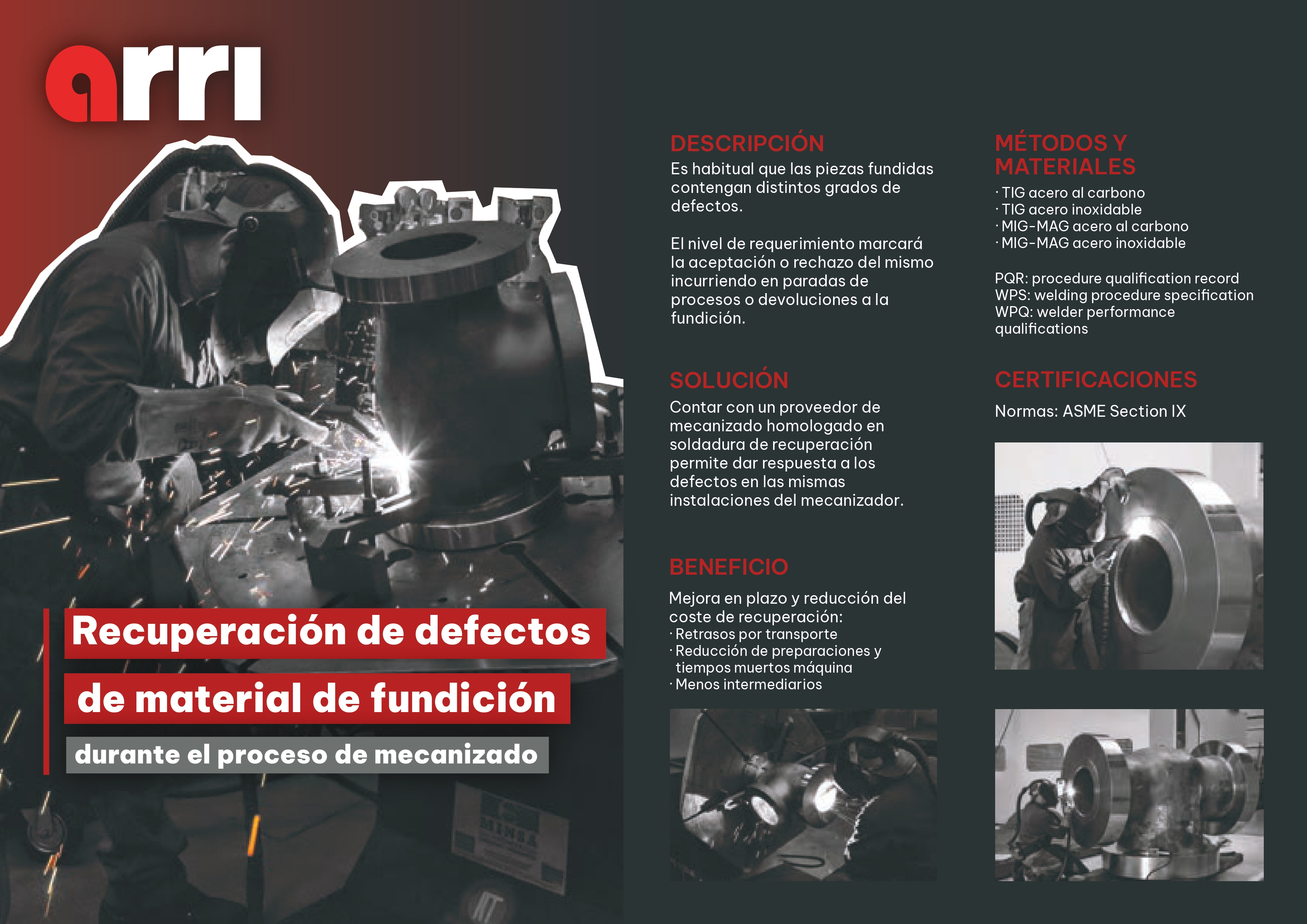
At Talleres Mecánicos Arri, casting repair by welding is neither an outsourced service nor an improvised workaround. It is a qualified, in-house process integrated directly into the machining workflow. When a defect emerges during work on a component, Arri has the capability to address it on-site, without relocating the part or subcontracting the intervention.
For the client, this has a clear and immediate implication: the issue is resolved where it is found, under the same traceability and quality standards that govern the machining process, with minimal disruption to the overall project schedule.
Arri's welding capability covers certified TIG and MIG-MAG methods in accordance with ASME Section IX, applicable to carbon steels, austenitic and martensitic stainless steels, and superalloys. Every repair is planned in coordination with the machining sequence, ensuring final tolerances are achieved through post-weld machining or grinding.
The Hidden Cost of Inaction
A defect discovered during machining can appear to be an isolated problem. But if a component enters service carrying an unrepaired discontinuity, or one repaired without adequate process control, its behaviour in operation changes fundamentally.
Industrial valves operate under pressure, thermal cycling, and in many cases handle aggressive or corrosive media. In these conditions, an untreated weak zone does not remain stable: it deteriorates progressively, accelerates localised corrosion, promotes fatigue cracking, and can lead to premature in-service failure.
The cost of that failure, which includes unplanned plant shutdown, emergency repair, and component replacement, is incomparably greater than the cost of a controlled weld repair carried out in the workshop. Repair welding, properly executed, is not merely a point-in-time correction. It is a long-term reliability decision.
How Weld Repair is Carried Out at Arri
The component repair welding process at Arri follows a defined, fully documented technical sequence:
-
Defect assessment: The nature, extent, and location of the defect are evaluated to determine the feasibility of repair and to define the deposition strategy.
-
Zone preparation: Contaminated, oxidised, or microcracked material is removed, and weld joint geometries are established to minimise stress concentrations.
-
Thermal control and pass sequence: Controlled preheat and interpass temperatures are applied, particularly critical for martensitic materials and superalloys, to prevent distortion and microcracking.
-
Filler material selection: Consumables are selected for chemical and hardness compatibility with the parent material, ensuring the mechanical properties and corrosion resistance of the component are fully restored.
-
Integration with post-weld machining: The weld is planned so that subsequent machining brings the geometry back to the required tolerances, guaranteeing coaxiality, parallelism, and flatness.
-
Non-destructive examination (NDE): Ultrasonic testing (UT), liquid penetrant testing (PT), or magnetic particle inspection (MPI) confirm the integrity of the repaired zone before the process continues.
The entire procedure is fully documented: weld consumables, process parameters, and inspection results. This traceability is part of the value Arri delivers alongside the finished component.
Weld Repair as an Asset to Client Production
Integrating industrial component repair by welding into Arri's production workflow reflects an operational reality of the sector: raw material is imperfect, and a high-calibre machining facility cannot limit itself to identifying a problem and passing it on. Resolving it is part of the service.
For valve manufacturers and industrial clients who outsource their precision machining, working with a facility capable of detecting, repairing, and continuing machining without interruption offers a concrete operational advantage. Fewer incidents to manage externally, fewer compromised lead times, and components that reach service with full integrity assurance.
At Arri, repair welding is precisely that: one more step within the process, not an exception to it.


