

An Inconel valve body has little in common with one machined using the parameters suited to carbon steel. Failing to machine each material appropriately can have a serious consequence: failure in service. The surface layer work-hardens during cutting, the tool degrades before completing the pass, and the seat areas are left with residual stresses and an irregular finish. The result is a part that may pass dimensional inspection and yet compromise sealing integrity when operating under pressure and temperature.
With special alloys, the material itself is not the problem. What determines final quality is the workshop's ability to adapt tooling, parameters, clamping and inspection to the demands of each material. This adaptation underpins ARRI's special alloy valve machining service, which routinely works with stainless steel, Inconel, duplex and stellite.
Why Special Alloys Require a Dedicated Machining Process
Special alloys are used in valves because they withstand corrosion, high temperatures or wear in conditions that conventional steel could not tolerate. Those same properties are what reduce their machinability. High mechanical strength at temperature, low thermal conductivity and a tendency to work-harden cause the heat generated during cutting to concentrate at the cutting edge rather than being carried away with the chip.
Each family of materials responds differently to these factors, which is why no single procedure is valid for all of them. Cutting speed, feed rate, depth of cut, tool geometry and coating, coolant and the sequence of operations must be defined according to the material, the geometry of the part and the function of each surface.
Stainless Steel: Controlling Work Hardening
Stainless steel is the most widely used material in valves for corrosive service. Its machining behaviour is defined by work hardening, particularly in austenitic grades. When the tool rubs the surface without actually cutting, or when the feed rate is insufficient, the material hardens locally and the next pass encounters a layer harder than the base material.
Avoiding this effect requires a continuous, positive cut, with sharp tooling and rigid clamping that eliminates vibration. In large-format parts, where machined surfaces are extensive and cycle times long, this stability is decisive in maintaining a uniform finish across the entire part.
Inconel and Nickel-Based Superalloys
Inconel, in grades such as Inconel 625 and Inconel 718, belongs to the nickel-based superalloys used in valves for high-temperature service, aggressive media and nuclear or chemical applications. It is one of the most demanding materials to machine. It retains its mechanical strength at elevated temperatures, dissipates heat poorly and work-hardens rapidly, which accelerates tool wear and makes surface finish harder to control.
Machining Inconel requires moderate cutting speeds, a tooling strategy designed to withstand high thermal loads and strict control of surface integrity in functional areas. ARRI works with this material in both machining and welding. Its welding procedure qualification under ASME Section IX, the standard of the American Society of Mechanical Engineers, includes Inconel 625. This allows material deposition or recovery to be integrated into the machining process itself when the part requires it.
Duplex Steel: Mechanical Strength and Dimensional Stability
Duplex steel combines an austenitic and ferritic microstructure that gives it high mechanical strength and excellent corrosion resistance, particularly in the presence of chlorides. For this reason it is common in valves for desalination, subsea applications and oil and gas.
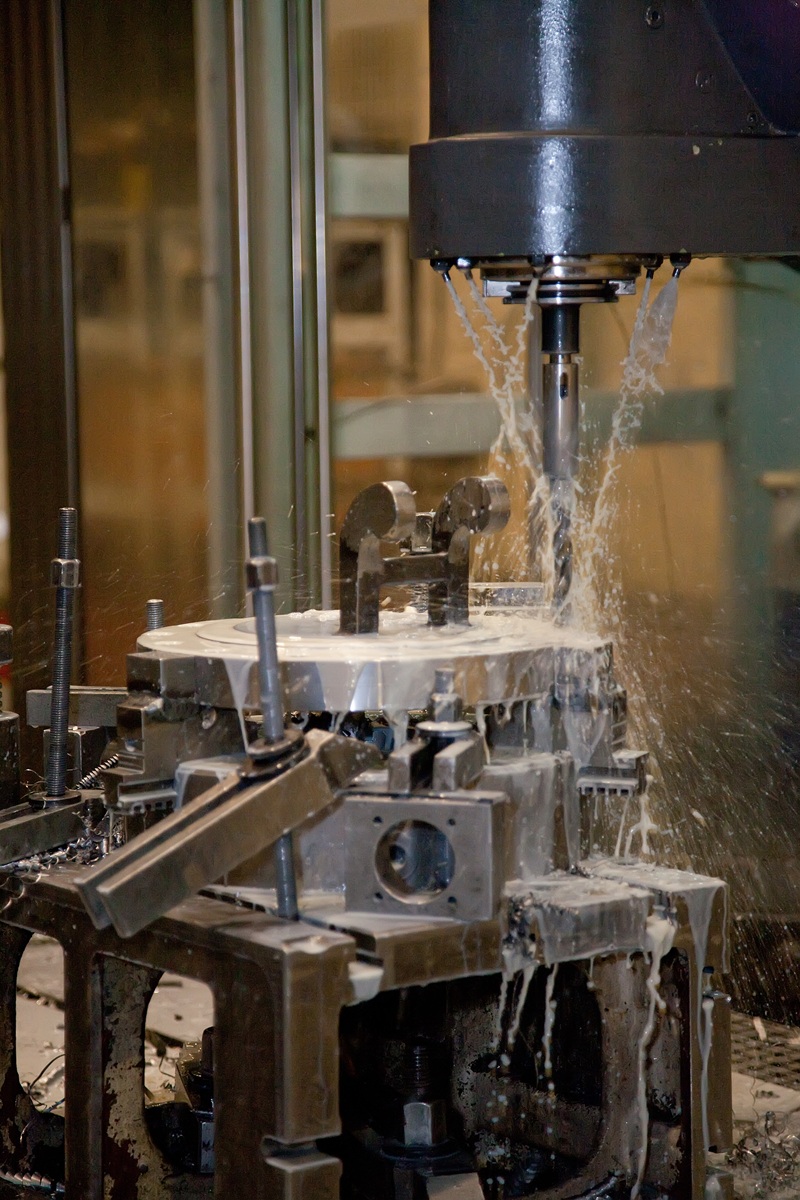
Its greater strength compared with austenitic stainless steels translates into higher cutting forces and greater demands on both tool and machine. In large components, managing these forces is key to preventing distortion during machining. Machine rigidity, fixture design and the roughing and finishing sequence therefore have a direct bearing on the dimensional stability of the finished part.
Stellite: Machining High-Hardness Surfaces
Stellite is a cobalt-based alloy commonly applied as a hardfacing on seats, discs and other areas of the valve subject to wear, erosion or friction. Its hardness is precisely what gives it value in service, and also what makes it one of the most complex materials to machine.
On these surfaces, machining calls for tooling capable of cutting high-hardness materials, tightly controlled parameters and planning that takes account of the overlay thickness, so that final dimensions are reached without compromising the functional layer. Precision at this stage is critical, because stellited surfaces are usually those that ensure the valve seals.
How ARRI Adapts Its Technical Resources to Each Material
ARRI's expertise in machining special alloy valves is built on more than 30 years of specialisation and a technical infrastructure designed for large-format parts. Its Trevisan machining centres can handle parts with turning diameters of up to Ø2,400 mm and weights of up to 25 tonnes. The rigidity and capacity of this equipment are particularly relevant when machining high-strength materials in large components.
Integrated turning and milling, combined with computer-aided manufacturing (CAM) programming, allows specific machining strategies to be defined for each material and each geometry. This is complemented by ARRI's own modular clamping systems, which allow parts with special geometries to be fixtured within 24 hours. Appropriate clamping is decisive in controlling vibration and distortion in high-strength materials.
Welding is integrated into the same process through TIG and MIG-MAG procedures qualified under ASME Section IX. This qualification covers materials such as martensitic steels and Inconel 625. Final dimensional inspection is carried out on a Zeiss coordinate measuring machine, which verifies that the required tolerances and geometries are met on every part. The entire process is carried out under a quality management system certified to ISO 9001:2015.
Applications and Valve Types
This capability enables ARRI to machine gate, ball, globe, check, plug and butterfly valves in special alloys, as well as fittings and other components, from medium sizes through to large dimensions. These parts are destined for sectors such as oil and gas, nuclear, chemical, cryogenic and subsea applications and desalination, where the material is chosen for its performance in service and machining must fully preserve those properties.
ARRI: Large-Dimension Valve Machining in Special Alloys
Working routinely with stainless steel, Inconel, duplex and stellite equips ARRI to take on the most demanding machining. Each material is approached with its own strategy, backed by high-capacity machinery, qualified welding, Zeiss dimensional inspection and a team with more than three decades of experience in valve machining.
If your project requires the machining of valves or components in special alloys, ARRI's technical team can review your requirements and propose the most suitable solution. Contact us.


