

The rise of green hydrogen and new energy technologies is imposing unprecedented requirements on the manufacturing of industrial components. Valves intended for these applications must operate under conditions that combine extreme pressures, cryogenic temperatures, and sealing demands that exceed traditional industry standards.
Machining valves for renewable energy applications has therefore become a highly specialised field, where dimensional precision and material selection are critical to ensuring safety and performance in demanding applications. New facilities—from hydrogen refuelling stations to storage and distribution systems—require components capable of withstanding long operating cycles without physical or chemical degradation.
Machining for Renewable Energies: Regulations, Materials, and Traceability in a Growing Sector
Unlike other industrial sectors, the regulatory framework for hydrogen is still expanding, although consolidated technical references already exist. Standards such as ISO 19880 regulate key safety aspects, while the Pressure Equipment Directive (PED 2014/68/EU) continues to serve as the basis for certifying and validating mechanical components.
One of the fundamental challenges lies in material compatibility. Advanced stainless alloys and hydrogen-resistant superalloys must demonstrate their performance against embrittlement, stress corrosion, and intense thermal variations. Full traceability of each material batch—from chemical composition to thermal history—is indispensable to ensure suitability in environments where any defect can lead to leaks or structural failures.
Demanding Absolute Precision: Machining Valves for Critical Applications
Renewable-energy machining requires high-performance equipment capable of maintaining dimensional stability even in prolonged processes or when working with complex geometries. Machining valves for hydrogen demands micrometric tolerances to ensure total sealing, as even the slightest deviation in sealing surfaces can compromise system integrity.
Multiaxis machining centres, active thermal compensation, specialised tooling, and advanced CAM programming have become essential elements of the process. These technologies help anticipate and correct deformations, minimise internal stresses, and produce surface finishes that prevent leakage even under very high pressures.
In some cases, the process includes repair or buildup welding operations, always carried out under validated procedures. This integration makes it possible to correct imperfections or adapt specific areas without restarting the entire manufacturing process, preserving overall precision and significantly reducing production times.
Advanced Quality Control and Non-Destructive Testing
In the manufacturing of hydrogen valves, quality control extends far beyond dimensional verification. Non-destructive testing, such as ultrasound, liquid penetrant inspection, or industrial radiography, is required to ensure the absence of internal or surface discontinuities. This level of inspection is necessary due to the nature of hydrogen, whose low molecular density makes it one of the most demanding fluids in terms of sealing and operational safety.
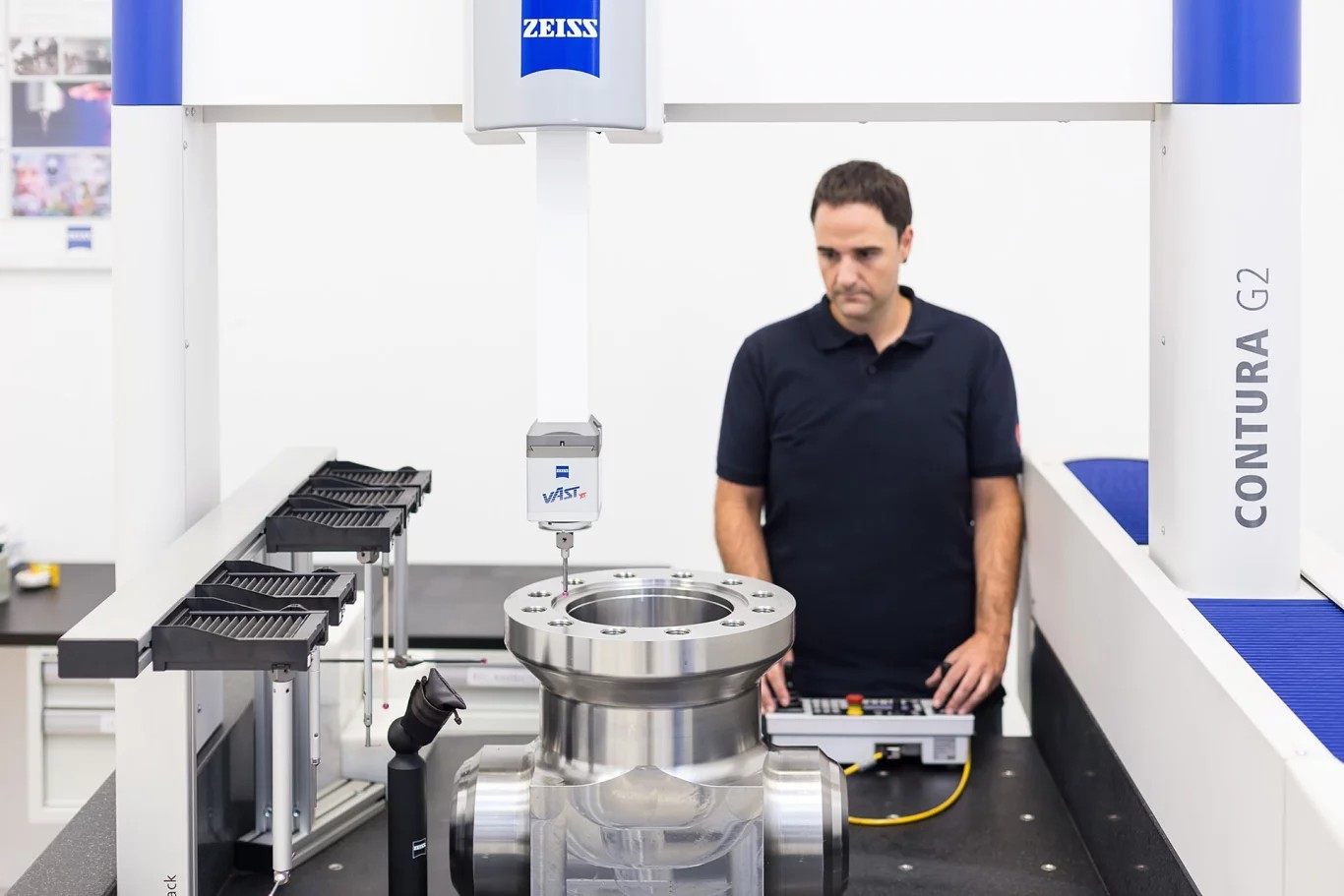
Coordinate measuring machines (CMM), detailed geometric reports, and complete document validation are part of the standard production workflow, strengthening component reliability before delivery.
The Value of an Integrated Service in a High-Criticality Sector
For all these reasons, having an integrated valve machining service becomes a key factor for manufacturers. Companies are not only looking for suppliers who machine parts, but they also seek partners capable of managing engineering, manufacturing, inspections, testing, and documentation within one coordinated system.
This integrated approach enables compliance with tight deadlines, reduces non-conformity risks, and ensures that every component is ready to operate under extreme conditions from day one. Machining valves for hydrogen is no longer an isolated process but an integrated chain that combines technical expertise, infrastructure, and a rigorous quality culture.
Arri as a Technological Partner for the Development of Advanced Energy Solutions
Arri has established itself as a benchmark in the manufacturing of valves and critical components for hydrogen and emerging renewable energies. Its high-capacity machining infrastructure, combined with advanced control systems and strong experience in technically demanding sectors, enables the company to tackle projects where precision and reliability are essential.
The company applies full traceability, certified procedures, and optimised manufacturing methodologies to meet the needs of valve manufacturers, EPC contractors, hydrogen station operators, and energy system integrators. Its approach combines engineering, metrology, precision machining, and documentation management to ensure that every component meets the sector’s strictest requirements.
In a rapidly advancing energy transition, technical excellence is a strategic asset. Arri plays an active role in this process, offering machining solutions capable of meeting the challenges of a sector that demands safety, efficiency, and reliability in every one of its components.


